Posts Tagged ‘history’
A Firebrand at Any Age…Margaret Owen
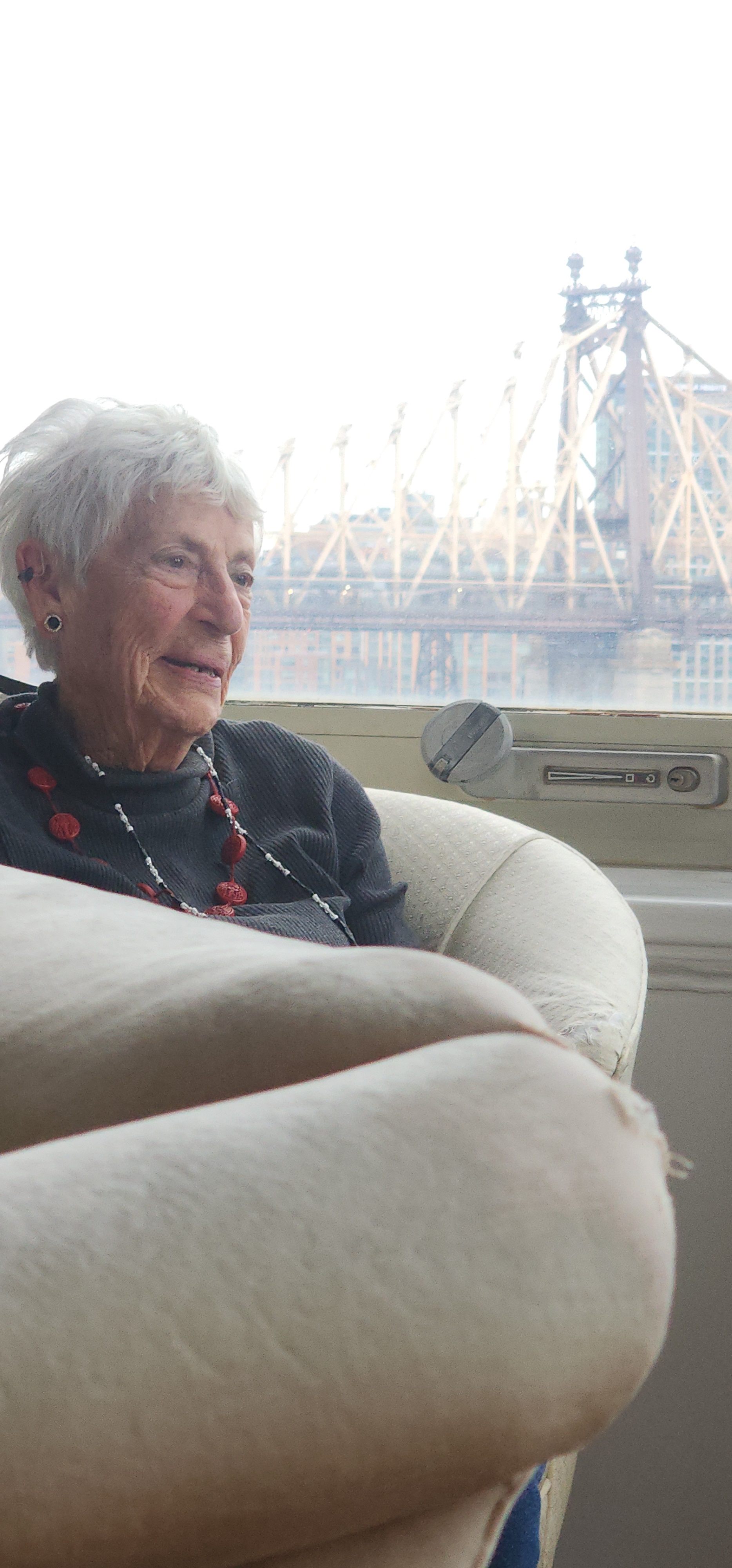
Standing at the Millennium Hotel, I wondered who might be already be there from the group SERVAS. I had been invited as part of the Commission on the Status of Women to meet the original couch surfers’ organization to talk about peace. Eyeing a chair, I asked the sitter if she were about to leave. When I told her I was hoping to be part of a peace meet up, she became politely irate. Can you have a peace discussion while the worlds on fire” she asked.
Margaret Owen is a Barrister, Human Rights Advocate, recipient of an Oder of the British Empire, an occasional actor and a mother of 4 and grandmother. She is also ninety-three years of age.
Of course, I couldn’t let this precious person with whom I almost share a birthday disappear into the night. I knew she had more in her brilliant mind than twenty of my younger friends and I asked her to meet me for coffee and share some of her life. I’ve been a member of a group called International Women in Radio and Television (IAWRT), yes, lots of initials at the UN…and I’d never met anyone like her before.
The next day Margaret beat me to the restaurant and before we had barely sat down, bubbling with the enthusiasm of a school, she listed some of the areas of injustice that most concern her. Cambridge educated, she speaks beautifully and it is no surprise that she played lead roles in several of Shakespeare’s plays while there, even reciting a bit of Portia as we waited for our grilled cheese.
The quality of mercy is not strained;
It droppeth as the gentle rain from heaven
Upon the place beneath. It is twice blest;
It blesseth him that gives and him that takes:
‘T is mightiest in the mightiest; it becomes
The throned monarch better than his crown
Margaret’s mother and father were born in England. Her mother’s family were originally from from Lithuania, her father Poland and have lived for three generations in the United Kingdom. Both her parents were both professionals, her mother practiced medicine. her father a solicitor. She was close to her mother but always felt that her two brothers were more important in her mother’s eyes. Perhaps this was the beginning of her understanding of patriarchy.
After Cambridge, studying law and becoming a Barrister, she worked at Granada television in documentaries, got a degree in anthropology as well as a Degree with Distinction in Social Administration from the London School of Economics. Her entire CV could put the D in Distinguished but she does not dwell on herself. Her main concerns are the victims of discrimination across the globe. She headed the Law and Policy division of the International Planned Parenthood Federation, been a founding member of Gender Action on Peace and Security UK, and monitored trials and elections in Turkey. She is also an adviser on women and children’s rights to the Kurdish Human Rights Project. And that’s just a few highlights.
“It was so strange to be in a room at the Church Center, where they were discussing aging as if it were something strange and here, I sit, being aged and not thinking there’s anything different about me,” she chirped.
She then raced on to the subject of UK Labor PM Keir Starmer’s cozying up to President Trump and the resignation of International Development Minister Annaliese Dodd from her job due to the cuts Mr. Starmer is making to development and aid in exchange for more funding for defense. And we are sending this money to Israel for war! she politely declaims. Owen is Jewish and spent six months in Israel in 1956 riding around on a lambretta and doing free-lance reporting. She travelled all over including Gaza and does not approve of the Israeli Prime Minister’s endless attacks on the Palestinians. In fact, upon her arrival back in London, she will stand with the JNP (Jewish Network for Palestine), a grass roots organization committed to debate on settler conflict in Palestine. It is anti-Zionist and she has met with her local Rabbi to discuss. She hopes to get arrested.
This s knowledgeable woman has an educated opinion on so many issues. As a human rights lawyer who believes in the law: it is abhorrent that there is a government that is now flagrantly violating international laws and structures set up after World War II to secure peace and prosperity for everyone. The world has changed last March to this March since Trump.
She mentions her son Dan, now working as an anthropologist for the World Bank in East and Southern Africa, telling her that he is already seeing the suffering around him since the laws have been changed and international agencies dismantled by Musk’s raiders.
Margaret takes no prisoners. She almost bailed from the CSW last year when Saudi Arabia had been chosen as the chair of the UN commission … a commission that is supposed to promote gender equality and empower women across the globe, the Ambassador to the UN from Saudi Arabia was chosen to chair the conference. They were unopposed in their bid for leadership despite being condemned by human rights groups and the kingdom’s record, most recently arresting a young woman activist for her twitter hashtag asking for the end of male guardianship. This appointment is a slap in the face to all the women who travel great distances and a great expense to come to New York to partake in this yearly event. Margaret’s friend, fDr. Carole Mann researcher and novelist, threatened to organize a boycott of the CSW in France unless the position was rescinded.
… instead of conclusions, I hear political declaration.
.
Margaret feels that the CSW’s draft should have emphasized the bush backs on women’s right rather than simply calling it progress which is uneven at best. She was very surprised that at the opening event, it was not even mentioned once at how how much the world has changed since Trump’s election.
There’s an extreme roll back in every part of women’s lives. Who would have imagined that women’s reproductive rights in 2025 are being slashed?
Each year she returns to the US hoping to see progress; after all, she was at Beijing where so many dreams were made.
Every aspect of women’s lives has touched Margaret. When her husband, an astro physicist died in1990, she found herself a widow at 58. She never stopped working, teaching judicial administration to Commonwealth magistrates. While hosting a Malawian mother and her sick baby she learned of the crisis of widowhood around the globe. The visiting woman could not believe that Margaret was permitted to live in her own house after her husband died and keep the things that “belonged” to him.
Widows’ lives in the Global south are determined by patriarchy, misogyny and misinterpretation of religion and traditions. They are treated like chattel with no right to their land and subjected to torture. Mourning and burial rights include drinking water from the husband’s corpse, and having sex with his cousins to show she is not guilty of her husband’s death. They are raped, their possessions are taken away and they are exploited as servants in the extended family. These practices are common to many countries in Africa and South Asia, differing according to cultures and religions. They should be defined as torture and criminalized.
In the Congo they can be raped and sometimes burned alive. They are called witches and stoned to death. They can be taken as a sexual slave or sent into the desert to die.
Widowhood exports poverty. Their daughters are withdrawn from school and are sold into forced child marriages, often with much older men. They then often become child widows themselves.
Their sons then become unaccompanied child asylum seekers, desperate to access education and decent employment so that they can support their widowed mother and younger siblings. It’s a vicious circle.
All of this led Margaret to founding Widows for Peace Through Democracy…the first international organization to address human rights in the context of the state of widowhood. For her contribution to the advancement of women’s human rights, and especially for her work on widow’s rights, Margaret received an Order of the British Empire in 2013.
But that is not enough for this dynamo. She is a Patron of Peace in Kurdistan, where she served as a witness and reporter to the trials of Kurdish activists in Turkey. Turkey has an official policy in place that denies the existence of the Kurds as a distinct ethnicity. An organization of activists PKK (called terrorists by Turkey) had been formed to liberate Kurds from Turkey. Their leader. Abdullah Ocalan, was imprisoned for 25 years along with countless Kurdish intellectuals, not even permitted to see a lawyer and isolated on an island.
Margaret is a huge fan of Ocalan. She believes his writings about equal rights and society are the most progressive and the book he wrote in prison, The Political Thought of Abdullah Ocalan, comparable to the writings of Mandala. Ocalan is now telling his followers to accept peace, even though Turkey will not legally allow its Kurdish citizens to speak Kurdish.
One might think a woman with this gusto could be exhausting. Not true. Her enthusiasm is catching as she is one of those geniuses who understands the limitations of others, humbly explaining everything, not to instruct, but to share. She wants you to feel what she feels and presents the facts, pouring them out of her head the way Dagwood Bumstead used to do math problems. She admits to having a photographic memory; that’s helpful for the data, but it’s her heart that is her real strength…feeling for the down trodden and using her smarts to balance the inequities of injustice.
I thought we might order rice pudding after our shared grilled cheese, but she was having a bit of a cough and cold and not hungry. With a coffee refill, she told me about her brand-new initiative. Drafted a few days before, she was setting up a campaign for all women in occupation—WAGLUO –whose voices are never heard at the CSW and many other places. They are too busy keeping out of harms way to get their stories out. This includes the Rohingyas, Yazidis, Kurds, Yezidis, Tamils, Baha, Baluchistans, and Kashmirs. among others. She hopes to introduce this to the UN this year.
She also hopes that the next head of the UN will be a woman but is doubtful that the men will share the power, so is willing to settle for a man and woman held leadership…something the Kurdish leader Ocalan describes in his book she so admires.
I’m certain that her days back in Europe will be jam packed… she’s been a member for a decade of an amateur theatre group, the Questers helmed by Dame Judith Dench, and may be hitting the boards again soon.
One of her last on-stage roles was that of Maria Josefa in Federico Garcia Lorca’s The House of Bernarda Alba. Margaret could in real life be less like Maria who represents repressed desire for freedom. Margaret has been speaking out for truth and freedom for woman and the downtrodden her entire life. Perhaps she is more of the character Hilde Wangel in the Master Builder:
I want my kingdom. The time’s up, you know.
photo courtesy of N.Cohen-koan
The Black Madonna Celebrated
by Nancy Cohen-koan

The Black Madonna is an icon of worship that can be traced back to pagan, pre – Christian times. She represents devotion to the Earth Mother, the African Goddess and to a time when people understood God to be female as well as Black. She is still revered in Italy and in New York there were no less than three churches that held worship for the Black Madonna in the East Village.
I.J. Isola, writing for the W.P.A. n 1936, noted: “The New York Black Madonna is credited by believers, with possessing the miraculous curative powers of the original (Sicily and other parts of Italy, Ethiopia, etc.), as is attested by the many votive offerings at her shrine.” Apparently, she could cure many of the parts of the body including arms, legs and breasts. Since pre-Christian times she has been the protector of gays, transgender and LGBTQ+ people, known as Femminielli in the Neapolitan Culture and Galli in Rome(where they were priests of the Phrygian goddess Cybele, or Magna Mater
Alessandra Belloni, a native Roman, studied in New York and realized that her true calling was honoring the Black Madonna through her love of Italian folk music. She learned the ancient tammorriata tradition of the Earth goddess and for 35 years has traveled the globe performing and doing research in this ancient form of empowerment. Along with her partner and fellow musician John T. La Barbera, they create a musical dance installation, as much art as sacred healing. I Giullari di Piazza, founded in 1980, specializes in medieval pilgrimage songs, Southern Italian tarantellas and devotional chants with ritual drumming. This concert celebrates the 45th anniversary of the group’s founding and features selections from its original opera, “Voyage of the Black Madonna,” which was a watershed creation for the company.
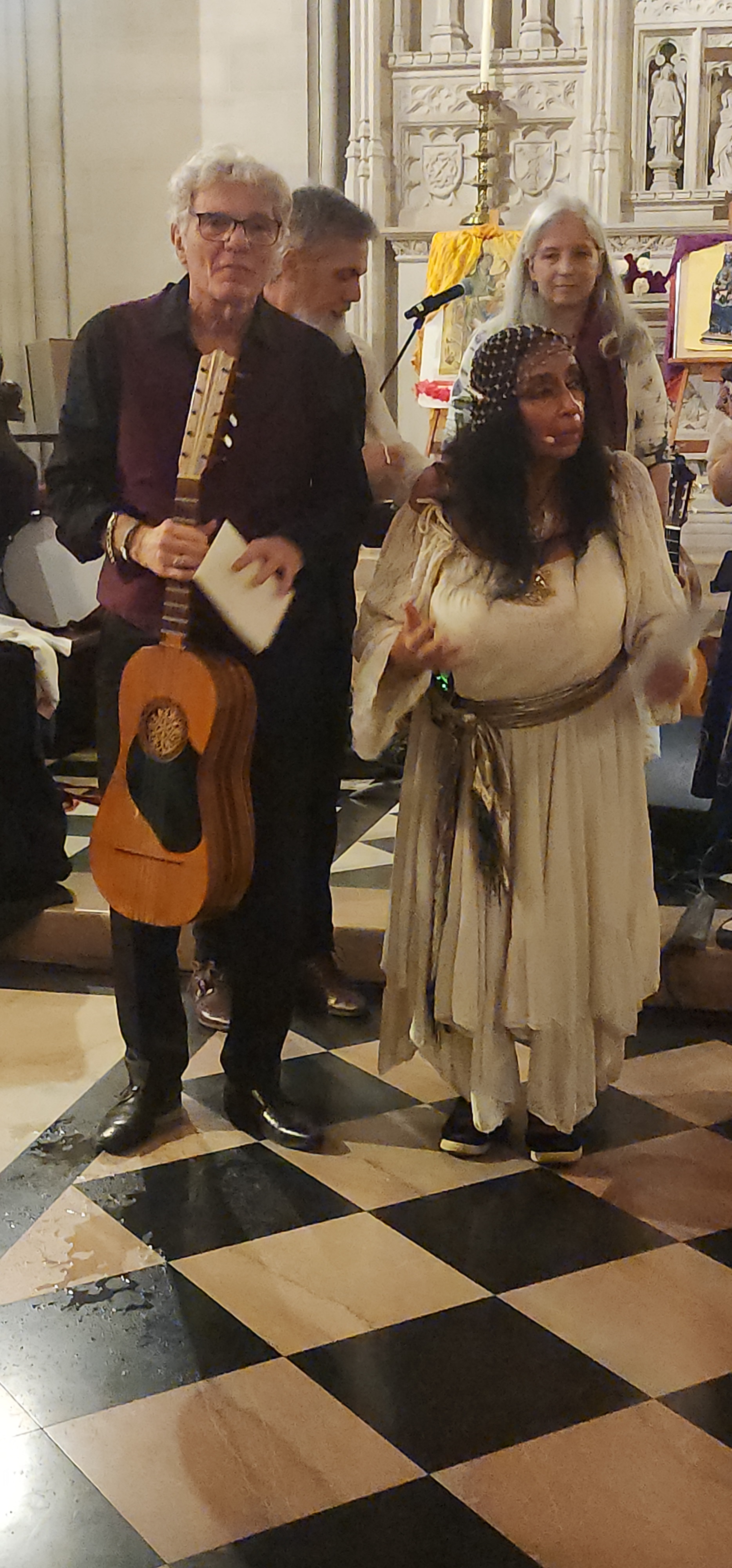
I was familiar with Alessandra before the show after watching a PBS program about buying houses in Italy, PBS series “Dream of Italy. She has a devoted following there and by the looks of the audience at St. John the Divine last Friday, one here as well. I saw many women signing up for her goddess -type classes; she infuses spirit and beauty and recognition of the female spirit. What could be bad?
In Alessandra’s show Mystic Rhythms & Sacred Chants for Seven Black Madonnas from Italy to Spain, she and her glorious troupe explore the different incarnations of the Black Madonna with ancient music, dance and stilt performance. It is a festive experience that recalls medieval street theatre, intoxicating and beautiful.
Her voice is deep and soulful and her percussion skills amazing… for this occasion, Giovannangelo de Gennaro from Puglia brought his magnificent voice… a voice perfectly suited for the wonderful acoustics of the chapel in St. John the Divine.
Graceful dancers performed wearing elaborate costumes… characters ranging from virginal maidens to the goddess who can control snakes…dancing with a real one. The Sun God on stilts moved through them, transporting all of us to another time where nature was revered and female power honored.
John la Barbera introduced a song which is based on pre-Christian notations of a melody found in Greece. He expanded on the tune and it was beautiful not only for his arrangement, but the knowledge that its origins are so ancient and yet feels so contemporary.
This magical show is a shoe in for Earth Day performances and must be included in environmental events that remind us of the power of nature and our requirement to love her and be grateful for her bounteous gifts.
Other musicians include: Mara Gerety (vocals & violin), Christa Patton(harp, oboe & recorder) and dancers, Francesco Silvano, Amaraand Mark Mindek (stilt dancer in the role of the Poet Virgil).
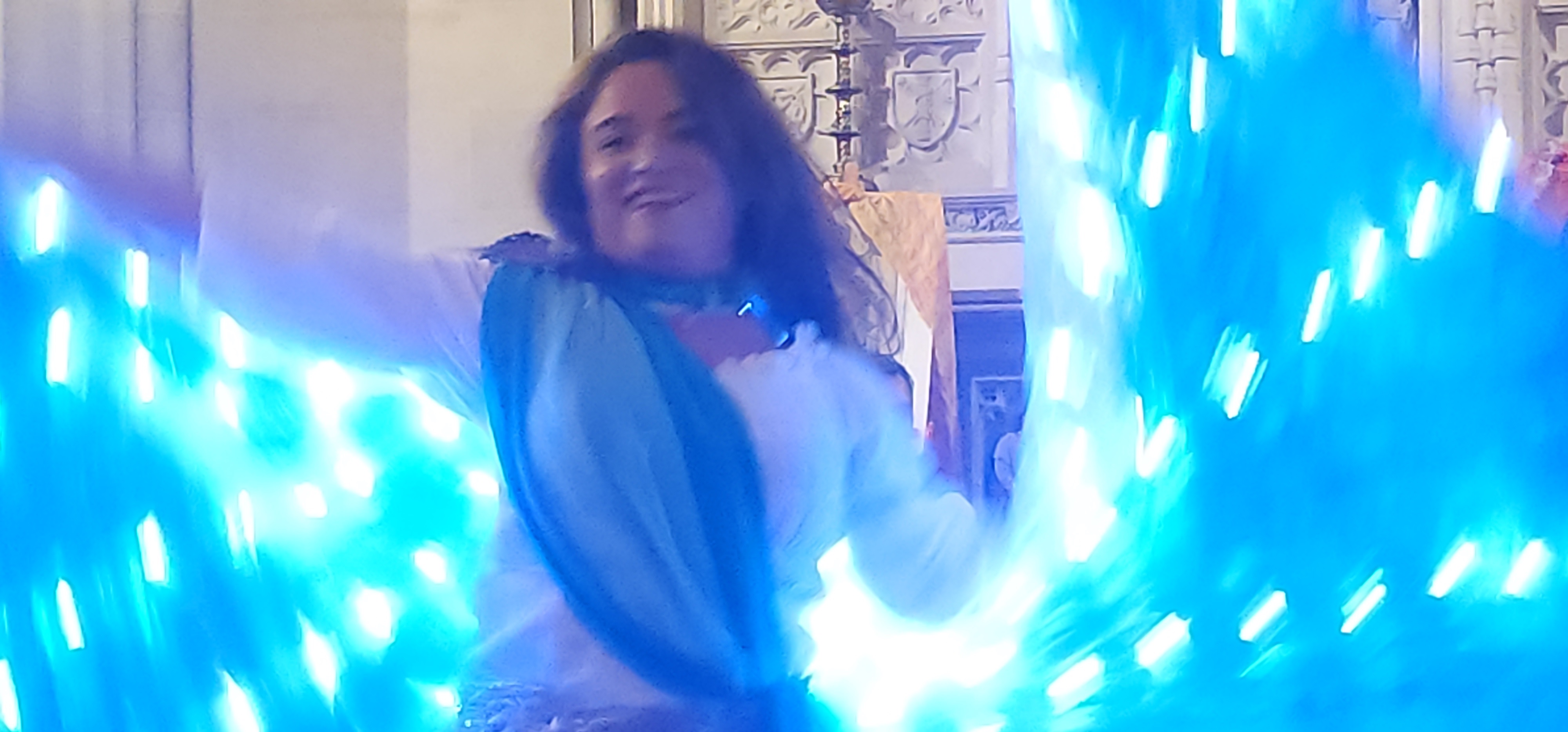
The troupe spends part of their time in New Jersey and Alessandra will be offering classes to the fortunate in New Jersey.
As for me, I’m dreaming to buy a place in Puglia and stay as close to the world that honors such a beautiful tradition.
For more information and future performance dates: http://www.alessandrabelloni.com
all photos by N. Cohen-koan
Mrs. Stern Wanders the Prussian State Library
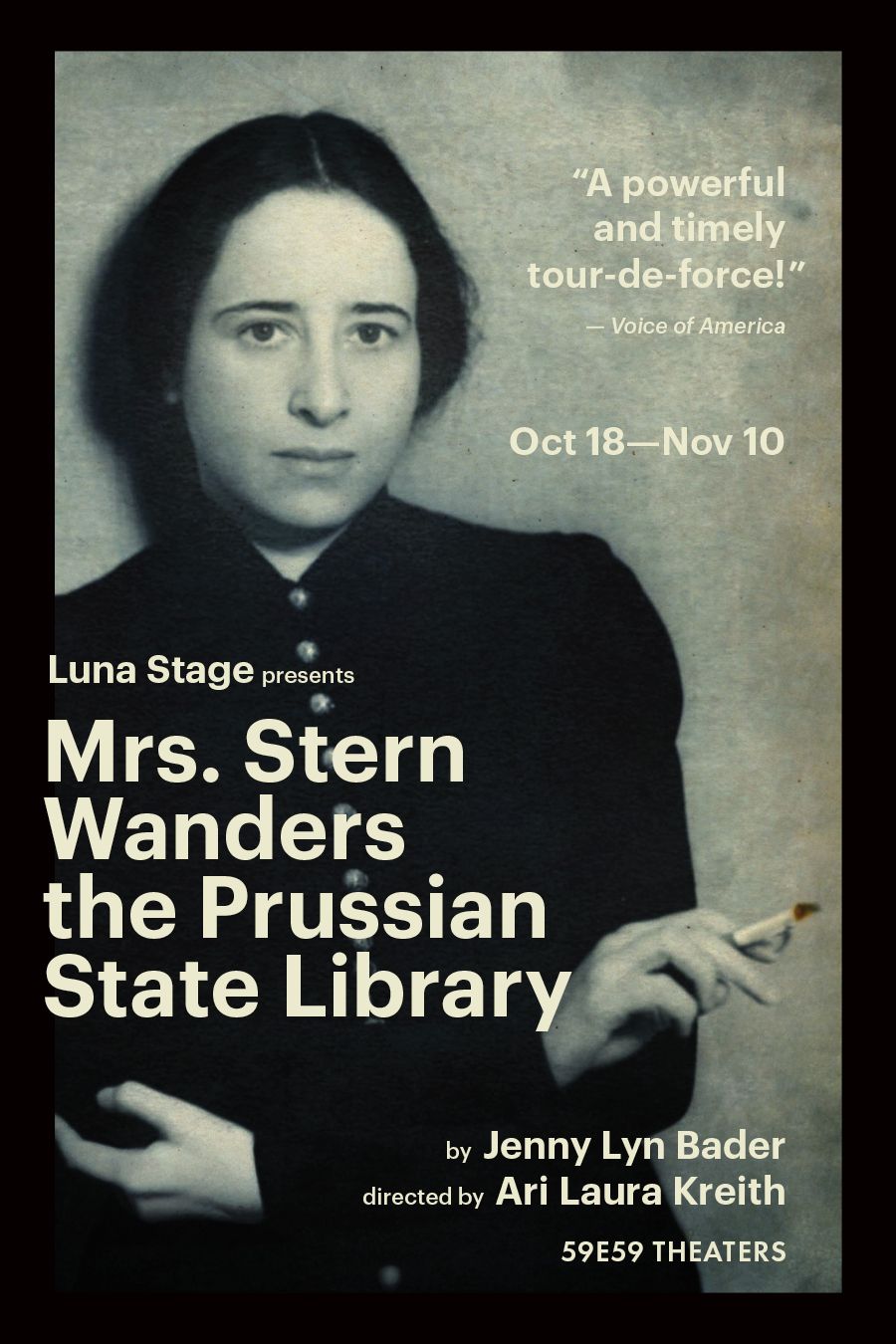
I don’t think we’ve ever seen Stockhausen syndrome quite like the relationship between philosopher Hannah Arendt and her Nazi jailor Karl in Jenny Lyn Bader’s Mrs. Stern Wanders the Prussian State Library. Arendt, as played by a very effecting Ella Dershowitz, has a mind like quicksilver. As soon as she observes jailor Karl’s ego needs to pull rank, she defers and reigns in her erudition in exchange for survival. Karl, once somewhat of a student himself, is in awe of her and we see his struggles to follow orders clash with his own instinctual curiosity. What can a good Nazi do in the hands of such a fine German mind, never mind that she’s a Jew?
Her crime it seems was to have been seen copying images of antisemitism from papers for a group who sends them abroad to advertise what’s really going on in Germany. She is aghast at hearing this…her pure research is what took her to the library and nothing else.
Hannah must balance a nature in pursuit of truth with a writer’s talent for bending the narrative in order to save her own skin. After all, she certainly was not uninterested in Jewish issues and Zionism as she tries to convince Karl. In fact, quite the contrary. Her deception is so sweet…she has an authentic love of German thinking and wouldn’t think of involving her ex-lover Heidegger for help. For every turn Karl makes to accuse her of a misdeed, she does a sharp right or left turn, leaving him in the dust. If she had any crime, it was neglecting her own research to hunt around through the files for a recipe for her mother’s favorite cake. The care and intelligence with which she describes the ingredients and making of the dessert is the same thoroughness she puts into her political theories.
Hannah has one visitor, Drew Hirshfeld, whose character Erich is symbolic of so many Jews who could not believe that their beliefs that they were true Germans meant nothing to the Nazis. He is a lawyer and has heard of her plight through the inner circles. Hannah is surprised that he has come or else pretends. Either way she is not excited to have him represent her, neither wanting her affiliation with anything Zionistic to be recognized nor believing he can do anything to help. He has the shadow of death all over him as he speaks of other lawyers who have been brought down while still trying to convince her and mostly himself that he will survive.
The environment is frightening, yet the humorous banter and cigarette sharing become between Karl and Hannah, gives relief. Through it we feel a razor thin light of hope. Karl has a child of his own and is not unfeeling to Hannah’s concern for her mother also imprisoned. Something stirs between them…perhaps it is their love of dancing or the way Hannah finishes the German folk poem Karl had begun reciting; both touchstones of their common humanity.
The acting is terrific in this play and the simple prison cell set serves as a blank slate for the plethora of ideas that playwright Bader make dance within the walls of the cell.
The play produced by Luna Stage is running at 59 East 59th Theaters until November 10th.
Never Look Away…beauty in truth
The film The Lives of Others, deals with the lives of East Berliners, separated by a wall and freedom. The Stasi – driven paranoia never permitted peace of mind, yet people lived with dignity as best they could. Even the Stasi operative reveals a human side. Director and writer Florian Henckel von Donnersmarck thrills again and even more so, with his new film, Never Look Away.

It is no surprise that Donnersmarck studied philosophy at Oxford. Every character thinks in this film… weighing their choices, confronting their destinies and we as audience, have the pleasure of experiencing this along with them.
Starring Tom Schilling and Sebastian Koch, Never Look Away spans three eras of German history from WWII to the Berlin Wall. Young art student Kurt (Schilling) falls in love with the daughter (Paula Beer) of an ex Nazi doctor (Koch) who disapproves of his child’s choice of partner and works at destroying Kurt’s self-esteem and their relationship. What they don’t know is that their lives are intricately interwoven through a crime that the Professor committed during the height of the Nazi regime.
This is a film that takes its time. When the allied bombs begin to fall, we see a montage… one family, separated through war, soldiers on the field, a young woman in an extermination camp (Saskia Rosendahl)…all of a family, disappearing in the ways wars make lives disappear. The music by Max Richter delivers the power and the futility of this most horrific of human endeavors.
Kurt, in art school, cannot immediately produce. We see the artist’s process as he struggles between expression and denial. It is not until his subconscious awakens through the help of a committed teacher and his own acceptance of the truth, that he is able to say something from his heart.
The Nazi Professor remains arrogant throughout. He is a perfect example of the blindness of racism — he sees neither his daughter’s happiness nor her pain nor is able to acknowledge his deeds. He is a man of such hubris that when leaving East Berlin, he doesn’t join his cronies in South America, but carries on his life in the West. This is frightening indeed. He is more machine than human and is played brilliantly by Koch.
Never Look Away is a powerhouse of a film. Honor, praise and gratitude bestowed on those who made this part of our human history so compelling.
produced by Jan Mojito Quirin Berg Max Wiedemann
Christiane Henckel von Donnersmarck
 notjustaboutsex